
In modern machinery and equipment manufacturing, plastic components serve not just as external housings but as critical functional parts that directly affect operational performance. Precision and tolerance requirements in industrial component plastic injection molding are becoming increasingly stringent, demanding that manufacturers master advanced technology and high-tech engineering materials. At Zeng Hsing, we provide specialized injection molding solutions, ensuring a perfect fit for every machine part with ultra-low tolerances.
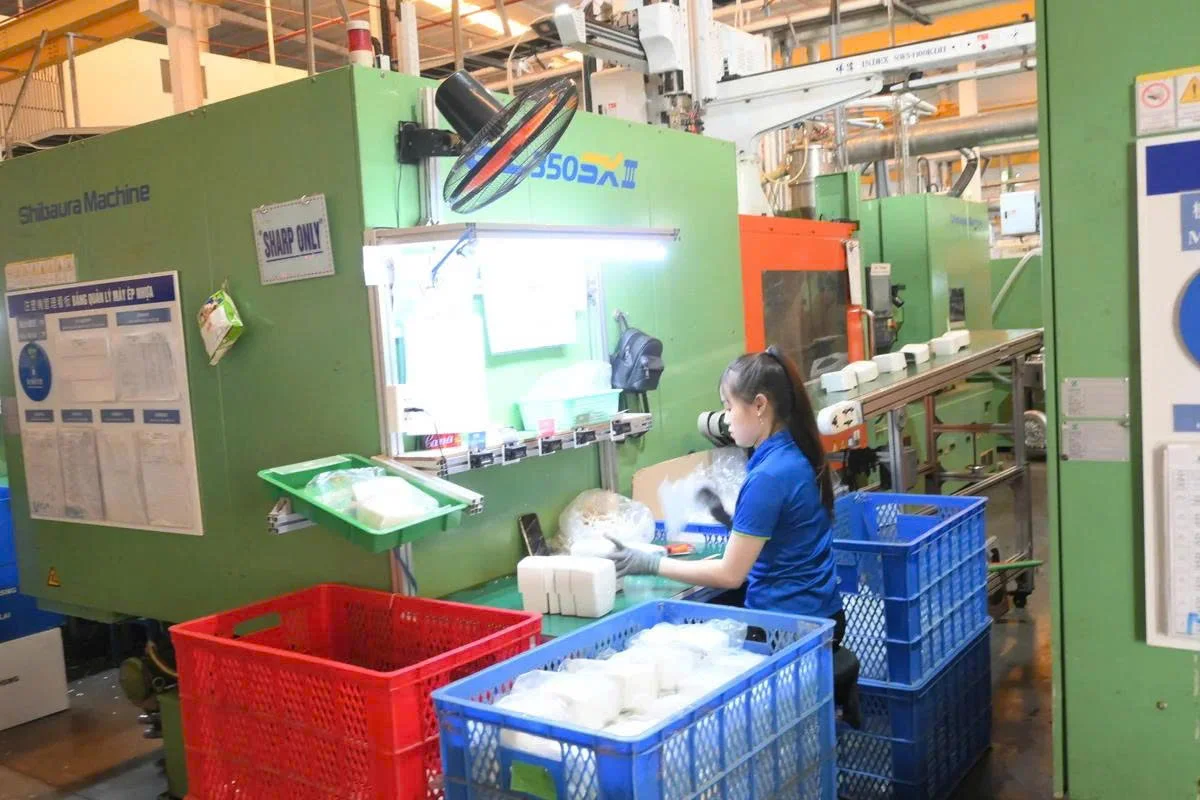
What is industrial component plastic injection molding?
Industrial component plastic injection molding is the fabrication process of specialized plastic parts that function as components of complete machinery or equipment systems. Unlike the production of standard consumer plastic items, this process focuses heavily on functionality, load-bearing capacity, and absolute fit precision, allowing components to operate stably in harsh industrial environments.
The difference between consumer plastics and high-tech engineering plastics
Distinguishing clearly between these two manufacturing types helps businesses select a factory with the right capabilities:
| Characteristics |
Consumer plastics (household plastic) |
High-tech engineering components |
| Primary goal |
Aesthetics, colors, low cost. |
Physical/mechanical properties, durability, precision. |
| Materials |
Commodity plastics (PP, PE, PS). |
Specialized engineering plastics (ABS, POM, PC, PA66). |
| Mold engineering |
Simple structure, wide tolerances. |
Complex mold design, high hardness, excellent shrinkage control. |
| Quality control |
Primarily visual inspection. |
3D dimensional measurement, durability testing, pressure, and temperature checks. |
>>>> See more: Custom high-precision engineering plastic processing provider at good prices
Typical industrial component groups and technical characteristics
Depending on their role in a system, industrial plastic components are divided into several groups with specific material and structural requirements:
– Drivetrain components: Includes gears, cams, guide shafts, and mechanical couplings. This group typically utilizes POM plastic thanks to its self-lubricating property, wear resistance, and excellent dimensional retention under frictional forces.
– Enclosure and load-bearing components: Machine chassis frames, PCB board brackets, and technical protective enclosures. Preferred materials usually include ABS, PC, or reinforced PC/ABS to ensure impact resistance, electrical insulation, and protection for sensitive internal parts.
– Connection components: Electrical connectors and plastic couplings within wiring systems. The primary requirement for this group is thermal stability and flame retardancy, preventing components from deforming when devices operate at high intensities.
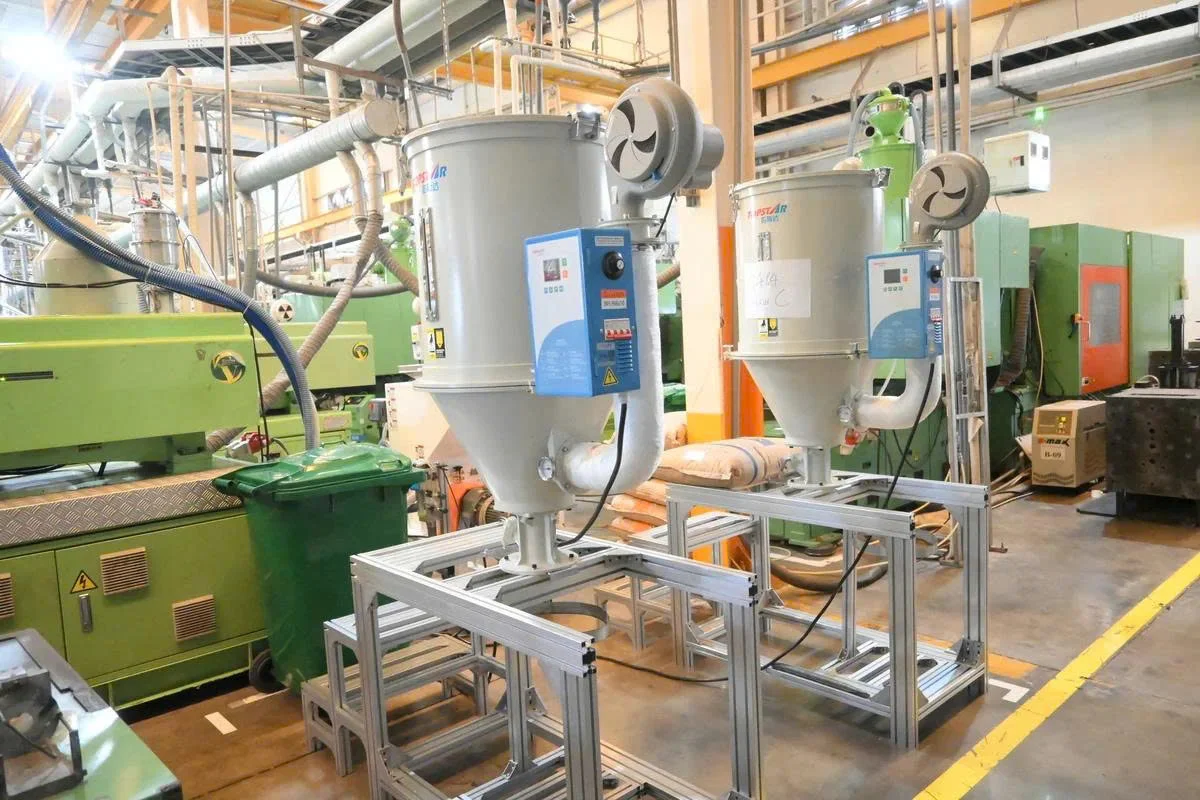
Clear classification allows the factory to propose optimal processing solutions, from selecting plastic resin to designing the mold cooling system, effectively eliminating shrinkage or warping issues after molding.
>>>> See more: Reputable OEM/ODM plastic component manufacturing partner in Vietnam
Modern technologies in industrial component plastic injection molding
To meet increasingly complex structural and functional component requirements, the injection molding industry has developed advanced techniques that integrate multiple functions into a single production cycle.
Insert molding technique
This technology involves placing a separate component (usually a metal part such as a screw, copper guide bar, or steel shaft) into the mold cavity before injecting the plastic. The molten plastic encapsulates and bonds tightly with this part upon cooling.
• Benefits: Creates robust, load-bearing, or conductive connection points without requiring subsequent manual assembly, thereby increasing bonding strength and reducing labor costs.
Overmolding technique (multi-material molding)
This technology allows a layer of plastic (usually a soft plastic like TPE or TPU) to be molded over a previously molded rigid plastic surface.
• Applications: Commonly found on components requiring a grip surface, anti-vibration capabilities, or an airtight/watertight gasket layer. Combining two materials gives the component the structural rigidity of an engineering plastic core alongside the elasticity and aesthetics of the external overmolded layer.
Ultrasonic welding application
For industrial components with hollow structures or complex geometric shapes that cannot be molded as a single solid piece, ultrasonic welding is the optimal solution. This technology uses high-frequency vibrational energy to generate frictional heat at the contact points, melting and bonding the two plastic surfaces together.
• Advantages: Creates exceptionally durable, airtight joints with rapid execution times (measured in seconds). It requires no solvents or adhesives, ensuring optimal cleanliness and aesthetics for the components.
>>>> See more: High-precision detailed plastic injection molding workshop
High-quality, competitively priced industrial component plastic injection molding workshop
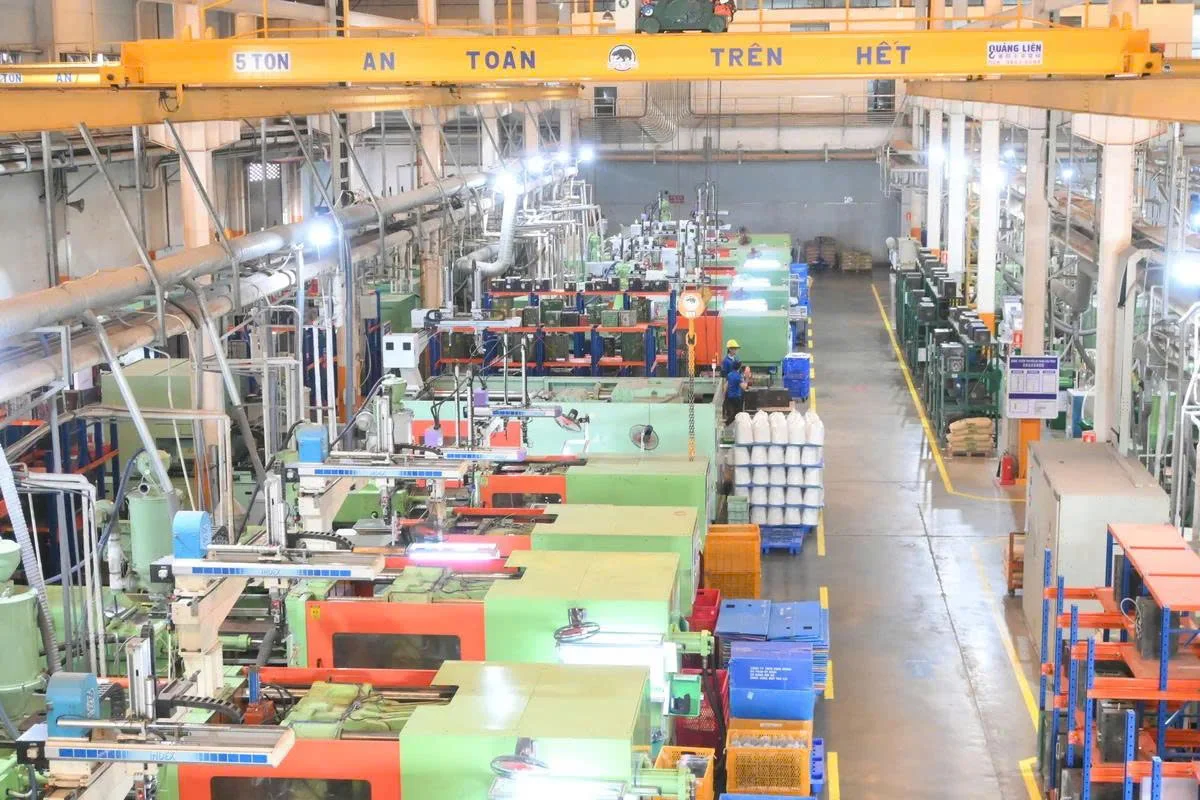
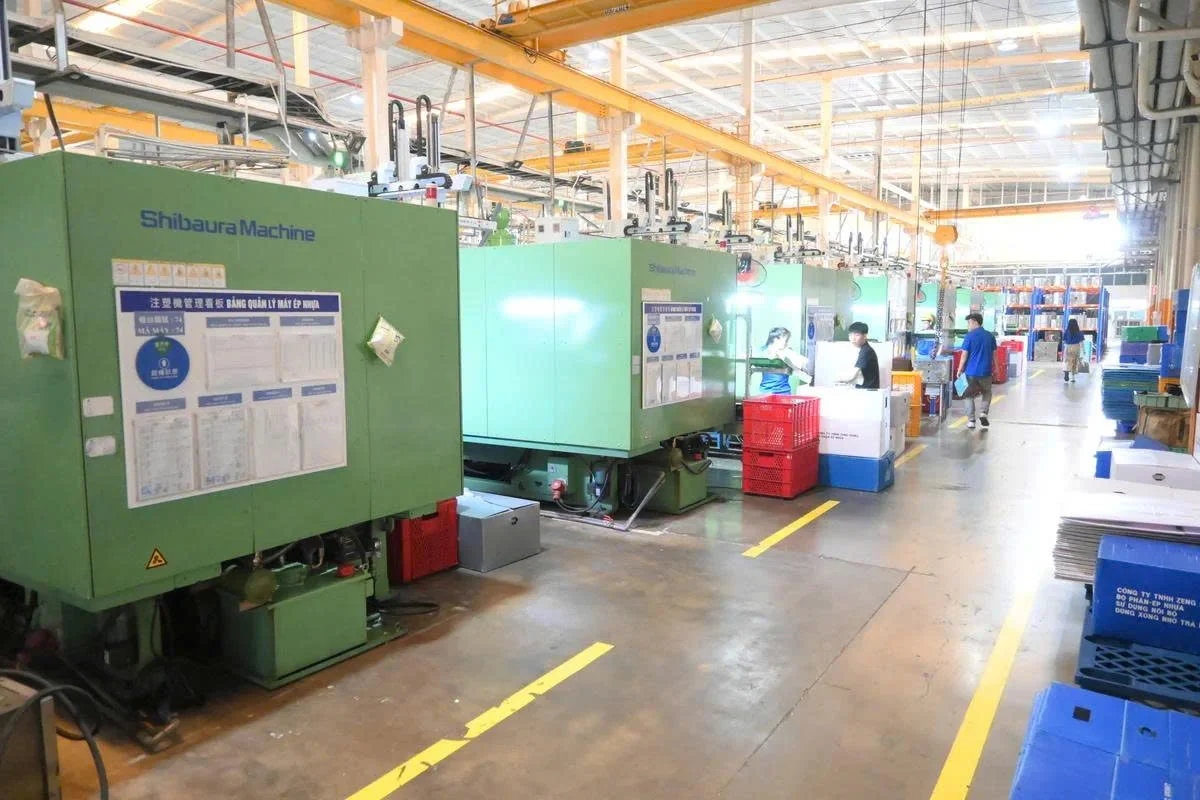
Zeng Hsing operates a large-scale manufacturing facility in VSIP II-A Industrial Park with a modern infrastructure of 91 plastic injection molding machines from Shibaura, Taichung, and Chen Hsong. Owning a wide clamping force range from 50 tons to 650 tons allows us to optimize production lines for all component types, from micro machine parts to structural enclosures measuring up to 800mm.
Our competitive edge in price and quality stands on 3 main pillars:
√ In-house mold autonomy: Our internal CNC center allows for on-site mold design and maintenance, reducing initial investment costs by 20-30% compared to outsourcing.
√ High automation: Utilizing robotic arms for part extraction maintains stable molding cycles, eliminates human errors, and keeps the defect rate (NG rate) to an absolute minimum.
√ Integrated model: The capability to assemble functional component modules on-site saves partners significant costs regarding logistics and intermediate supply chain management.
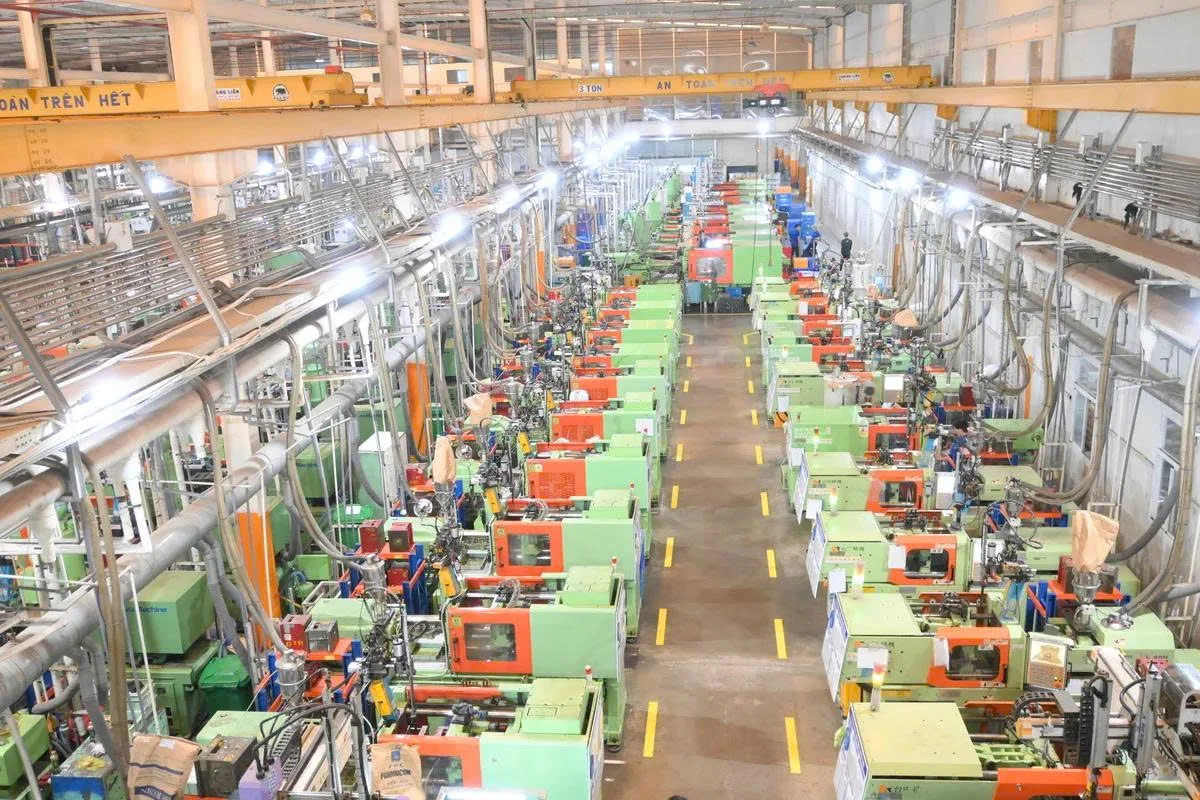
Operating under processes certified to ISO 9001 and ISO 45001 standards, the Zeng Hsing injection molding workshop commits to providing high-tech components at the most optimal production costs for OEM/ODM projects in Vietnam. If your business is looking for precise industrial component plastic injection molding solutions with ultra-low tolerances, please contact the technical department of Zeng Hsing directly for detailed consultation and quotations.
ZENG HSING VIET NAM
Address: Unit 03-08, Canary Plaza, Binh Duong Boulevard, Binh Hoa Ward, Thuan An City, Binh Duong Province, Vietnam.
Phone: (+84) 0355 846 965 (Mr. Nghia) – (+84) 0362 476 478 (Mr. Nam)
Email: nghia_duong@zenghsing.com.vn or nam_vu@zenghsing.com.vn
Website: zenghsing.vn
Related searches
industrial component plastic injection molding workshop
Affordable industrial component plastic injection molding
Engineering plastic processing
Custom plastic injection molding

