
Processing engineering plastics such as ABS, POM, or PC requires a much more stringent workflow than standard household plastics. However, in actual production, many businesses still face high defect rates and skyrocketing operational costs, alongside inconsistent output quality. This often stems from mistakes in technical and operational thinking. Below are the 5 most common mistakes that make engineering plastic processing inefficient, along with thorough ways to overcome them.
Overlooking the specialized resin drying process
Engineering plastics are highly hygroscopic. A classic mistake is relying on standard hot-air hopper dryers to heat the plastic instead of using specialized dehumidifying dryers.
When the residual moisture within the plastic resin exceeds the allowable limit (typically requiring below 0.02%), the water triggers a hydrolysis reaction under the high temperatures inside the injection barrel.
• Consequence: It breaks the polymer chains, making the product brittle, prone to cracking, and causing silver streaks on the surface.
• Solution: Invest in a closed-loop dehumidifying dryer system that controls the dew point at -40°C to ensure the material is completely dry before entering the molding cycle.
Suboptimal mold cooling system design
Within an injection molding cycle, the cooling stage accounts for up to 70% of the total time. A frequent error is designing cooling water lines that are too simple, failing to cover critical areas, or having uneven distances from the water lines to the mold cavity.
• Consequence: Inconsistent mold temperatures lead to localized shrinkage, causing defects like warping, deformation, or surface sink marks. This is exceptionally dangerous for POM plastic, which inherently possesses a very high shrinkage rate.
• Solution: Apply conformal cooling technology via 3D-printed mold cores, or meticulously calculate the cooling water flow to shorten cycle times and elevate dimensional accuracy.
Incorrect gate and venting parameter selection
To save excess plastic material, many facilities deliberately downsize the gate dimensions or place the gate in an unsuitable location. In addition, venting systems are frequently neglected or not cleaned periodically.
• Consequence: A gate that is too small generates extreme injection pressure, burning the plastic due to high frictional heat. Conversely, if venting is poor, gas accumulated inside the mold cavity will cause burn marks at the end of the plastic flow path.
• Solution: Utilize mold flow simulation software to determine the optimal gate location and position venting slots at the final gas trapping points.
Exceeding the allowable limit for recycled plastic usage
Utilizing regrind plastic is a way to trim costs, but overusing it acts as a double-edged sword. Engineering plastics degrade in mechanical and physical properties after passing through heat multiple times.
• Consequence: A recycled plastic ratio exceeding 15% to 20% will loosen the plastic's molecular structure bonds. The product might meet shape requirements but will completely fail durability, load-bearing, or heat-resistance tests in real-world environments.
• Solution: Establish strict regulatory standards regarding the recycled plastic ratio for each product type. For technical parts enduring high loads, using 100% virgin plastic is highly encouraged.
Lacking a preventive mold maintenance workflow
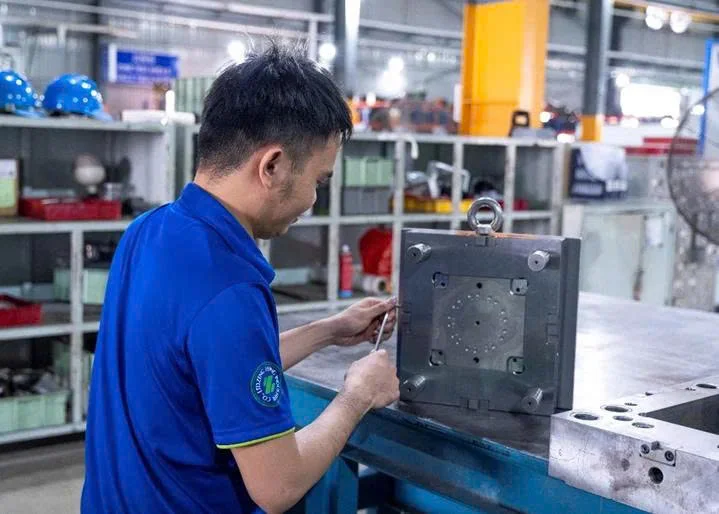
"Fixing it only when it breaks" is a mindset that severely degrades production efficiency. Injection molding engineering plastics generates a large amount of gas and resin residue that sticks to the mold surface.
• Consequence: When the mold becomes dirty, mating gaps get jammed, and the ejector pin system fails to operate smoothly, leading to product scratches or damage to the expensive mold itself. Unscheduled machine downtime for mold repairs wastes time and disrupts the production schedule.
• Solution: Establish a mold maintenance log based on shot counts. Every 5,000 to 10,000 shots, the mold needs to be taken down for cleaning, checking the spring and ejector pin systems, and lubricating moving components.
Engineering plastic processing goes far beyond just feeding plastic into a machine and injecting a product. It is a scientific process demanding precision from material preparation to mold technical operations. By avoiding the 5 mistakes mentioned above, businesses can not only elevate product quality but also optimize costs, solidifying their reputation in the highly competitive supporting industry market.
ZENG HSING VIET NAM
Address: Unit 03-08, Canary Plaza, Binh Duong Boulevard, Binh Hoa Ward, Thuan An City, Binh Duong Province, Vietnam.
Phone: (+84) 0355 846 965 (Mr. Nghia) – (+84) 0362 476 478 (Mr. Nam)
Email: nghia_duong@zenghsing.com.vn or nam_vu@zenghsing.com.vn
Website: zenghsing.vn

